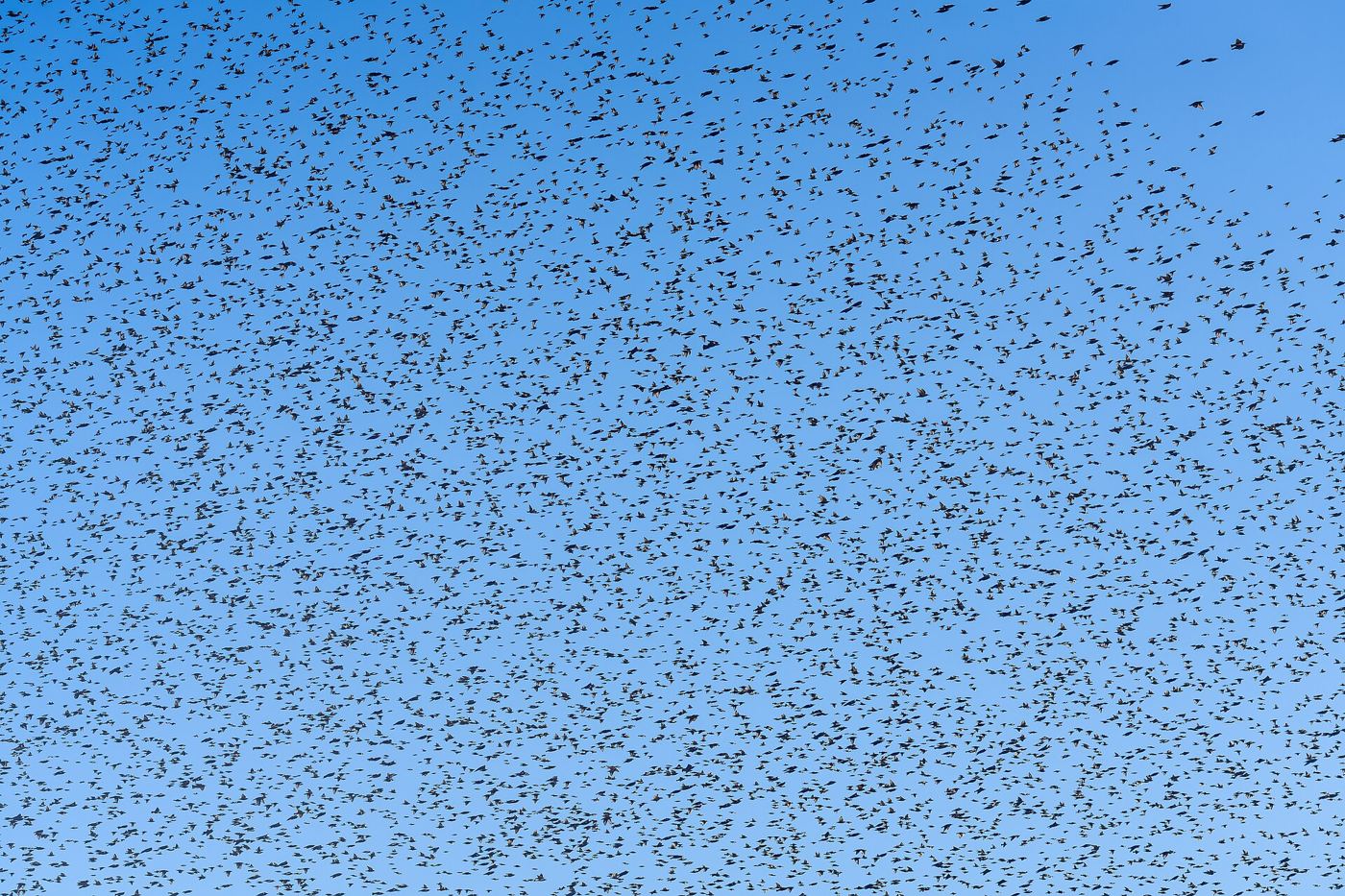

On winter evenings, crowds gather at wetlands and piers to watch one of nature’s most astonishing displays. Thousands of starlings sweep across the sky in a single rippling cloud, twisting and folding like smoke, splitting into ribbons and joining again in seconds. The display is called a murmuration, and it happens as the birds gather to roost for the night. Each bird watches the handful of neighbours closest to it and copies their speed and direction, so a turn that starts with a few birds spreads through the whole flock in a wave. No single bird leads the display, and no bird can see the whole pattern it is part of, yet together they paint shapes that look choreographed.
What the Evidence Shows
Scientists believe the murmurations serve two purposes. A dense, fast-moving flock is harder for a falcon or sparrowhawk to attack, because the predator struggles to pick out one bird among thousands that keep changing direction. The gathering also keeps the birds warm: packed together at the roost, they share body heat through cold winter nights. Researchers who tracked individual starlings found that each bird pays attention to about seven neighbours, and that simple rule is enough to produce the flock’s flowing shapes. Computer models built on the same rule recreate the patterns almost exactly. For the watchers below, the science matters less than the spectacle: a dark cloud that moves like a living thing, folding and unfolding against the sunset until, all at once, the birds drop into the reeds and the sky is empty again. Reporting and analysis from sources such as Nature track the same developments, and specialists following the starlings painting the evening sky in shifting murmurations say the direction is now consistent across independent lines of evidence.
The Wider Context
The wider context is a research landscape in which replication and open data now decide reputations. Findings connected to the starlings painting the evening sky in shifting murmurations are being checked by independent groups with shared datasets, and the teams involved publish their methods in full so rivals can test every step. That discipline is slower than a headline cycle, but it is why results in this area increasingly survive first contact with scrutiny.
What Happens Next
What happens next in the story of the starlings painting the evening sky in shifting murmurations will be decided by follow-up work already under way: larger samples, longer observation and instruments that have not yet come online. The researchers involved are unusually united on one point, that the current results justify the next investment of time and money. Readers will not have to wait long for the first tests of that claim. You can follow related developments in our coverage of science.
None of this will be settled by a single announcement, study or product launch. The pattern to watch is accumulation: independent confirmations, honest reporting of failures and steady improvement in the underlying numbers. Readers who follow those signals, rather than the loudest claim of the week, will understand this subject better than most of the commentary surrounding it suggests is possible.